Excavations
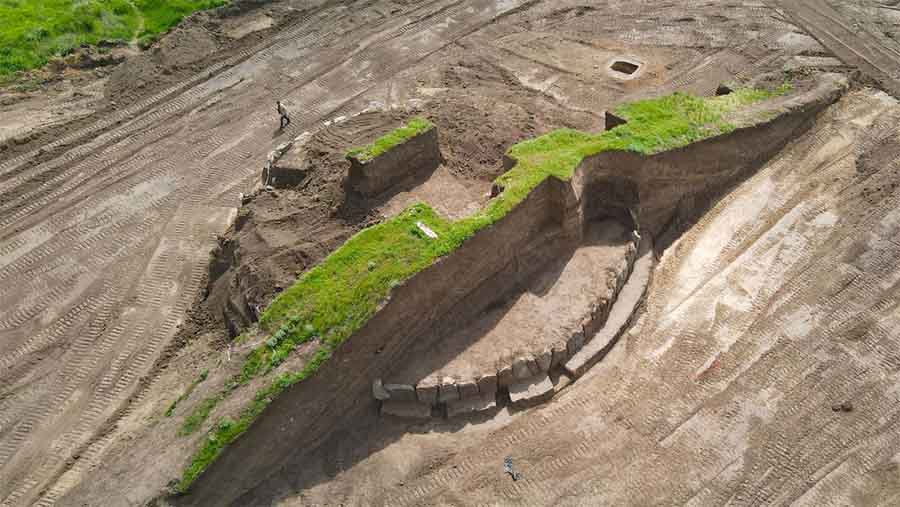
In early 2021, archaeologists began excavating a huge mound south of Dnipro in central Ukraine; it was 7.5 meters high and 50 meters in diameter.
Inside the mound, they found gigantic stone blocks several meters high.
Each stone weighed about a ton, and the builders carefully cut them into a circle.
Such circles of standing stones are called cromlechs.
This megalithic construction turned out to be 5,500 years old and dates back to the Early Bronze Age. It is older than Stonehenge and the Pyramids of Giza by at least half a millennium.
Some sensationalists wrongfully named this ancient structure the ‘Ukrainian Stonehenge,‘ but it is in fact an ancient burial mound.
Cromlech
The stone cromlech with a diameter of 18 m surrounds the mound. It consists of 64 fitted granite blocks about 2 meters high, each weighing between 0.5 and 1.5 tons.
The total weight of the cromlech equals about 70 tons.
It was established that the boulders were quarried in the area of the Dnieper Rapids, situated approximately 12 km away.
The original mound, created around 3,500 BC, was about 30 meters in diameter and 4 meters high and was subsequently enlarged over the centuries.
The blocks were dug to a depth of 0.5 m or less, and partly simply placed on the ground.
The southern and southwestern sides of the cromlech were installed slightly higher than the rest to compensate for the difference in elevation of the terrain and maintain the alignment of the tops of the stones along the horizontal line.
It is assumed that the cromlech served the role of strengthening the mound, as well as playing a sacred role, fencing off the world of the dead.
Ceramics
Candidate of historical sciences, associate professor Dmytro Teslenko was the head of the Dnieper archaeological expedition of the Security Archaeological Service of Ukraine.
According to him, the kurgan dating is determined by fragments of ceramics with a high content of ground shell found in the mound that are characteristic only of this period.
Interestingly, the same ceramics with ground shell are found among finds from the Trypillian culture.
It means that the two peoples not only coexisted during the same time period, but also interacted with each other.
At the same time, those peoples led completely different lifestyles. While the Trypillians led a sedentary life, farming in the forest-steppe zone, the Novooleksandrivka burial mound contains the remains of nomadic steppe herders.
Initial Burial: The ‘Pianist Man’
For whom was the cromlech kurgan initially built?
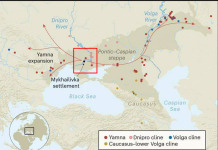
In late June 2021, archaeologists discovered a primary burial in the center of the mound associated with the Yamna culture.
The burial contained the skeleton of a man with no burial goods, except for a clay “bread” mixed with red ochre.
He was approximately 40 years old and of a very fragile build with thin, long fingers.
His unusually long, slender, and well-preserved finger bones stood out dramatically compared to other heavily built skeletons typical of the Yamna pastoralists.
Anthropologists and archaeologists working on the site gave the man the moniker the “mystery man with the hands of a pianist”.
He was probably a very important leader or priest, because for his burial the tribesmen dragged seventy tons of granite slabs from the Dnieper rapids area to build the cromlech and poured four hundred tons of soil.
Following the completion of the excavation, the skeleton was transferred to Kyiv for comprehensive DNA and anthropological analysis to uncover his exact origins, diet, and physical health.
Burials of Different Epochs
Novooleksandrivka kurgan served as a sacred cemetery for roughly a thousand years. Excavations uncovered 24 other unique burials spanning multiple distinct archaeological eras, including the Kvitianska/Post-Mariupol, Yamna, and Catacomb cultures.
Some burials were lined with grass. Burial pits were covered with wood, a layer of chalk, and lime.
In one of the ancient burials of the Early Bronze Age, archaeologists found traces of mummification, and the body was apparently without internal organs.
Many burials show traces of skulls being painted with a red mineral paint called ochre in intricate designs.
Indo-Aryan Rite?
One such skull particularly stood out. Its forehead was painted with red ochre, and stripes of ochre were applied under the eyes. The face was covered with a cloth.
Dmytro Teslenko claims that the catacomb burials had two imprints that are associated with Indo-Aryan mythology.
Catacomb Culture
In one of the burials of the Catacomb culture, under the walls of the kurgan, an entrance passage led into the shaft.
At the bottom of the shaft, a crypt-room was created underground, and then in the first crypt, the second one was made. In such a way, a single catacomb burial had two burial chambers in it. Catacomb construction of this type proved absolutely unique for this area.
Grave Goods
Stone artefacts such as an altar stone, hammerstones, whetstones, a hammer-axe dating back to the Chalcolithic, Bronze Age, and Early Iron Age were found in Novooleksandrivka kurgan.
A fragment of an axe-hammer from the primary mound of the kurgan was of particular interest to the scholars.
The studies showed that it was made of Dolerite-basalt and had traces of repeated use as a multi-functional tool. This pounder-grinder, hammerstone, and axe belonged to the Yamna Culture period.
Traditionally, hammer-axes are considered a prestigious category of burial equipment.
Significance
Because the standing cromlech required highly organized collective labor, archaeologists suspect it was built to entomb elite figures of prehistoric pastoralist societies, such as tribal chieftains or shamans.
Ukrainian authorities plan to preserve the fully exposed standing stones as an open-air museum.
Mycenaean Catacombs
More than a thousand years after the Megalithic Kurgan in Ukraine was built, the so-called Mycenaean Civilization appeared in mainland Greece, which lasted from approximately 1750 to 1050 BC.
According to modern archaeological discoveries, similarities between the Catacomb culture and Mycenaean civilization are particularly striking. These similarities include types of socketed spear-heads, types of cheekpieces for horses, and the custom of making masks for the dead.
The book Cradle of Civilizations takes a closer look at other similarities between the two cultures.
The book Royal Scythia, Greece, Kyiv Rus offers an answer to the question of why there are such striking similarities between the Yamna culture and the Scythians.