


The excavations of the grandiose Scythian funeral complex at Alexandropol in Ukraine were described in the previous video on this channel.


Alexander Liutsenko, who excavated Alexandropol kurgan in 1854–56, was the first to preserve the skulls of the people who were buried in it. Unfortunately, he did not preserve the skeletons as well.
However, the archaeologists of that time did not collect any of the skeletons’ remains, so science lost extremely valuable information from almost 40 royal barrows in the lower Dnieper area.
Liutsenko uncovered five skulls, which are numbered as follows. Skulls № 1 and № 2 are the ones found in the central chamber.
№ 3 is the skull of a servant whose skeleton was found in the passage adjacent to the main chamber.
№ 4 is the skull of a groom whose skeleton was discovered not far from a horse burial.
And № 5 is the skull of yet another person found in a royal north-eastern chamber.
Karl Ernst von Baer
The first scholar to analyze the skulls was a member of the Russian Academy of Sciences, Karl Ernst von Baer, and the results were published in 1866.
Von Baer observed: These skulls differ greatly from each other and can be divided into two absolutely distinct groups:
Three of them, № 1, 2, and 5, should be defined as short and wide, and two others, № 3 and 4, should be defined as long and narrow.”
In Baer’s opinion, the two long skulls were so similar in different measurements that they should belong to persons of one nationality.
Although the three short skulls were less similar to each other, the difference was not so big that they could not belong to people of one nation.
In the comparative table, the anthropologist called the nation of the three short skulls the Scythian nation.
The other two skulls he simply defined as the Elongated Skulls.
The heading of the table says: The dimensions of the described skulls are expressed in Russian (English) inches and lines.
And the eight columns are.
One. The greatest length from the lower part of the forehead to the most prominent point of the back of the head.
Two. The height from the foramen magnum (the large opening at the base of the skull) to the highest point of the crown.
Three. The height from the lowest point of the back of the head to the line touching the highest point of the crown.
Four. The greatest width is at the temples.
Five. Width of the crown between the parietal tubercles.
Six. The width of the forehead at its narrowest point.
Seven. The width of the cheeks, measured between the highest bends of the zygomatic arch.
Eight. The circumference of the skull, measured from the lower part of the forehead, through the temples, and the back of the head, to the same place on the forehead.
The widest of the three skulls of this group was skull № 5, and, according to Karl Baer, the skull was “unusually heavy” because of the bone thickness.
Skull № 1 was also very heavy but not as wide as the previous one.
Skull № 5
Alexander Liutsenko, who discovered the skulls, left a note describing the skeleton of № 5: The skeleton bones, judging by their size, belonged to a man of a large height and stout build.
Above the head of that large man, under the very wall of the catacomb, a silver object was discovered, bearing some resemblance to a staff, in Liutsenko’s opinion.
The upper end of this staff, lying above the head of the deceased, was turned towards the side of the Royal Tomb.
Curiously, the staff turned out to be a silver composite spindle of Greek type.
What was the spindle doing in the burial chamber of the powerful man?
One cannot help feeling the vibes of the legend of Ariadne’s thread in this underground symbolism of Alexandropol kurgan.
Of the three royal skulls, skull № 2 was the most gracile.
Initially, it was believed to belong to a man, too, despite the fact that the burial assemblage in the central chamber strongly suggested that a male and a female were laid to rest in it.
Present-day anthropological analysis showed that skull № 1 from the Central tomb of the Aleksandropol kurgan belonged to a man of the advanced age of 50 years or more, and skull № 2 belonged to a young woman of the age of 20-35 years.
The present-day analysis also confirmed the heterogeneity of the anthropological structure of the buried in the Aleksandropol kurgan. Scholars established that “the royal group” from Alexandropol kurgan shows similarity with the Sauromatians.
Hippocrates on Scythian Race
Who were the Sauromatians and where did they live?
One of the most outstanding figures in the history of medicine, Hippocrates, wrote in the 5th century BC, even before the Alexandropol Kurgan was built:
“And in Europe is a Scythian race, dwelling round Lake Maeotis, which differs from the other races. Their name is Sauromatae“.
As can be seen, the Father of Medicine viewed the Scythians as a race. Not a tribe.
He also observed that the bodies of the Scythians had a peculiarity of shape that did not resemble any other nation, because of the effect of the cold weather.
In other words, the Scythians were formed by a cold climate. There is no way such a transformation could have taken place in 3 or 4 hundred years if the Iranian migration theory is accepted.
Scythians were local to the Dnieper River area, a fact that has been recently confirmed by DNA studies. The reference to one such study is available on the current video channel.
Symbols
Sauromatians or Sauromatae were not the same as the Sarmatians.
The chief divinity of the Sauromatae was the Mother Goddess.
As a reminder, two iron plaques representing a winged goddess holding two beasts were found in Alexandropol kurgan.
Two bronze pole-tops with the figure of the same goddess with her hands on her hips were discovered in it as well.
Other pole-tops portrayed griffins and birds.
Also, there was the famous bronze pole-top in the shape of a trident, with its prongs ending in sculptured birds with little bells in their beaks.
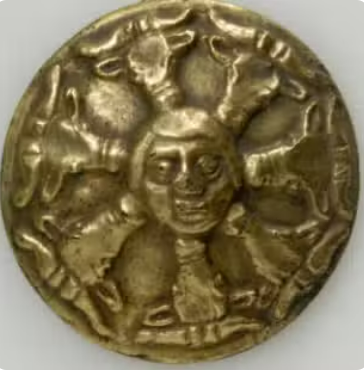
But the most intriguing in the current context are four gold plaques with a design of a human head surrounded by seven bull heads.
The human head on the plaque appears to resemble the shape of the royal skulls found in the central chamber. The man is cleanly shaven and has a curious haircut with a parting, and the oxen appear to be kissing him.
One of the names for the bull is Taurus, and the famous Taurica, which we now know as Crimea, is only several hundred kilometers from Alexandropol kurgan.
At the time the Alexandropol Kurgan was being built, the rulers of the Bosporan Kingdom situated in Pantecapaeum, which is present-day Kerch, used griffins on their coins resembling the griffins on the Alexandropol pole-tops.
They used tridents as their symbols, too. Interestingly, the modern studies showed that some types of stone used in the Alexandropol retaining wall, such as marbelised limestone, may have been brought from Crimea.
A hypothesis that the couple buried in the Alexandropol Kurgan belonged to a ruling dynasty of the Bosporan Kingdom may be supported by the fact that eventually there were rulers with such names as Sauromates.
The book Royal Scythia, Greece, Kyiv Rus takes a closer look at the Bosporan Kingdom and some historic events of world-scale proportion that took place in it.