


Achilleid of Statius


Achilleid is an unfinished epic poem by Publius Papinius Statius that was intended to present the life of Achilles from his youth to his death at Troy.
Publius Papinius Statius was a Neapolitan poet of the 1st century AD who was famous during his lifetime and exerted a strong influence upon the literature, learning, and thought of the Middle Ages a millennium later.
For example, his Achilleid was preserved in ninety-five manuscripts and was imitated, among others, by Joseph of Exeter, Dante, and Chaucer. Dante even made Statius a part of his Divine Comedy masterpiece.
Achilleid was used in schools from the tenth century onwards and became one of the six elementary Latin texts in the popular medieval schoolbook known today as the Liber Catonianus.
Statius owed his Greek literary education to his father, who, before becoming a popular teacher of Greek and Roman literature, was a champion in the poetic contests at Naples.
Statius himself won several poetic contests and even received the golden crown from the hand of the emperor Domitian.
The Achilleid is an account of Achilles’ early life with the centaur Chiron and an episode in which his mother, Thetis, disguised him as a girl on the island of Scyros.
The renowned 19th-century Scottish Professor of Greek, William Geddes, expressed his opinion that the Achilleid was written by a more ancient author and defined it as palaeozoic.
We have found the Achilleid to present barbaric and palaeozoic features, he wrote in his manuscript Problems of Homeric Poems.
Chertomlyk Gorytos
In the same 19th century, the Royal Scythian Kurgan of Chertomlyk in central Ukraine was excavated.
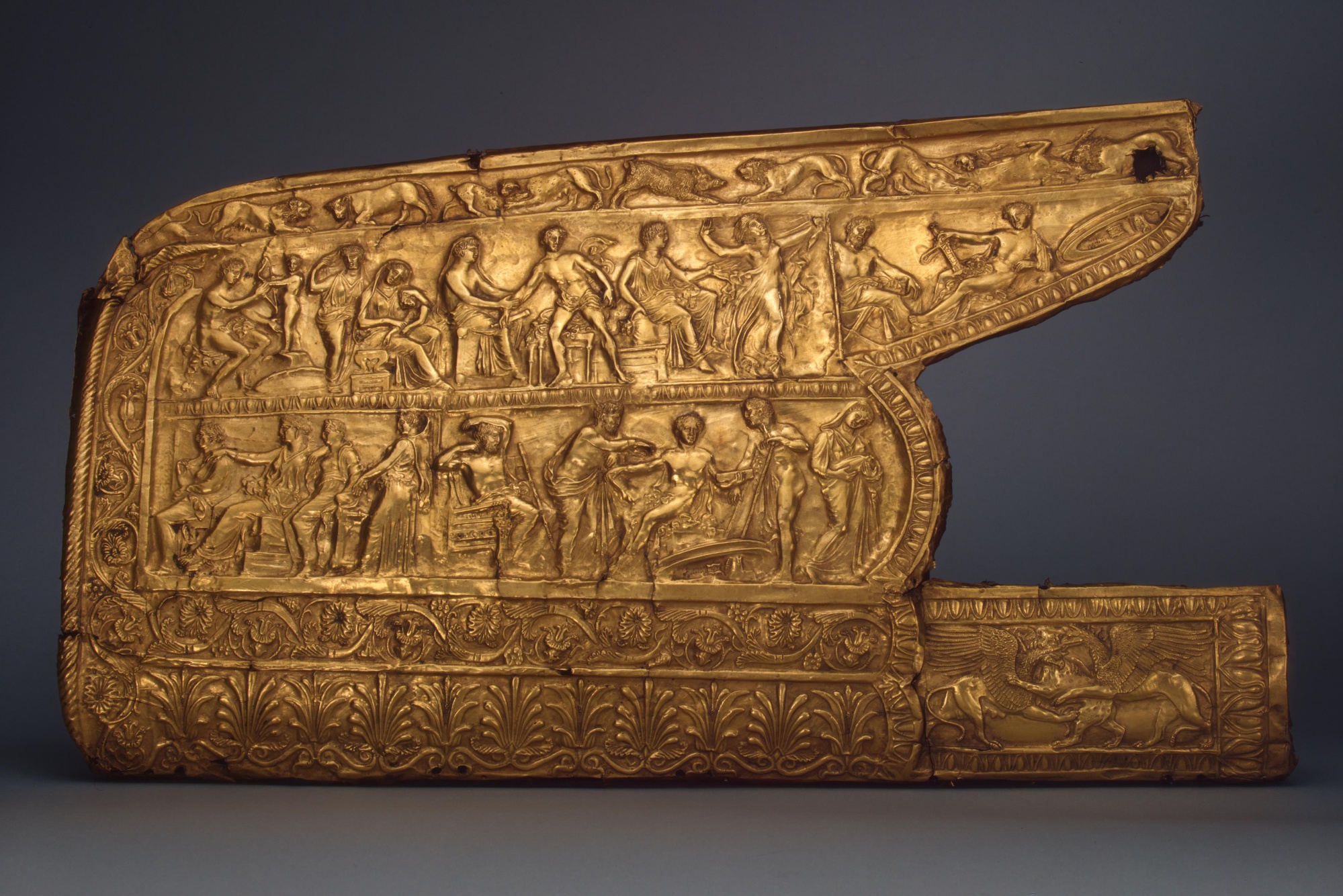
Among many world-famous artifacts dating to the 4th century BC, a bow-and-arrow holder of a Scythian King was discovered.
The gold plaque covering the gorytos, another name for a bow-and-arrow holder, depicted several mythological scenes.
British archaeologist Dr Ellis Minns, in his book published in 1913, devoted a lot of attention to this object.
According to him, it was Prof. C. Robert who suggested that the gorytos depicted the scenes of the Achilleid epic.
Achilles and Centaur Chiron
In one corner, we see boy Achilles learning to shoot. Notably, the boy Achilles holds a Scythian-type bow.
In the Achilleid, Achilles describes his apprenticeship with Chiron in the following way:
“Hardly had my uncivilized life turned twice six circles of years when he was making me outrun the swift deer and the horses of the Lapiths, and making me pursue by running the arrows sent ahead.”
Thetis
Achilles also says that his stay with Chiron started even before he could walk, and it was his mother, sea-goddess Thetis, who entrusted him to the Centaur at such a young age.
In the Achilleid, the Centaur becomes far more to Achilles than the simple teacher of medicine he was in Homer’s Iliad. In one instance, Achilles refers to Centaur Chiron as the second father.
But when Achilles is 12 years old, Thetis comes to the cave of Chiron below Mount Pelion to take her son away.
The reason is that Thetis had seen the ships of Paris stealing Helen away from Greece. She knew that her son was fated to die in the course of the upcoming war and tried to change his tragic destiny.
First, she approached Neptune and asked him to sink Paris’ fleet, but Neptune refused to interfere. It was after this attempt that Thetis went to Chiron and took Achilles away, deceiving the Centaur about her real intentions.
Achilles at Scyros
She brought her son to the island of Scyros in the Aegean Sea, whose king Lycomedes had several daughters but did not have a son.
Thetis asked Achilles to put on female clothes and act like a girl.
At first, Achilles refused to do so, but after seeing the king’s beautiful daughter Deidamia and her sisters, he agreed to be able to get closer to Deidamia.
Thetis dressed Achilles as a girl and introduced him to Lycomedes as Achilles’ sister with the following words:
We hand over this sister of our Achilles, o king! Don’t you see how she is fierce in her cheeks and is equal to her brother? Full of spirit, she was seeking to bear weapons and a bow on her shoulders, and to reject marriage in the way of the Amazons.
Achilles and Deidamia
Deidamia quickly understands that the new girl is actually a young man, but keeps it secret and teaches Achilles behaviour appropriate to his feminine disguise.
They enjoy each other’s company, flirting with each other.
One night, Deidamia takes Achilles to a sacred grove where the men were forbidden to enter.
Overcome with passion and love, Achilles could no longer control himself and rapes Deidamia.
Realizing he did wrong, he tries to console Deidamia and reveals his identity.
The girl sees herself as sharing in the blame, and her love for Achilles makes her stay silent about the event.
Achilles stays with Deidamia throughout the pregnancy until the child is born.
She eventually delivers a son, but they keep their relationship and their child a secret.
Diomedes and Odysseus
At that time, the Greek forces start preparing for the Trojan War, and according to prophecy, they can win the war only with Achilles in their ranks.
Prophet Calchas divines that Achilles is hidden by his mother on Scyros, and Odysseus and Diomedes set out to find him.
Odysseus explains to Diomedes that cunning will be necessary, and they dress like merchants.
They are warmly welcomed by Lycomedes, but do not state the real reason for their visit and present themselves as tradesmen selling their wares.
The king orders his girls to welcome the visitors. Interestingly, Statius likens the daughters of Lycomedes during the reception to the Amazons from the shores of the Azov Sea.
Were they dressed as the Amazons, or were they allowed to act as those famed female warriors? We can only imagine how the Amazons feasted after their victories.
In that atmosphere, Achilles starts losing his disguise, and Odysseus instantly notices a girl who stands out.
Deidamia restrains Achilles and stops him from getting up from the couch and demanding wine.
Odysseus decides to unmask Achilles by bringing a mixture of gifts to Lycomedes that include weapons among the flowers and ribbons.
They lay out gifts for the king and his daughters, and one “girl” is more interested in the weapons than the jewelry.
Odysseus whispers to Achilles that he knows his real identity, and, as previously arranged by Odysseus, a war trumpet sounds out at that very moment.
Achilles Discovered
Everyone scatters, but Achilles grabs the weapons and runs to confront the fictional enemy, thus revealing his true nature as a warrior and defender.
Lycomedes learns the truth.
When calm is restored, Achilles drops the shield, turns toward the king, and addresses Lycomedes in bare arms: “Dear father…”
Achilles deferentially puts aside his weapons and submits himself to the power of Lycomedes because he had promised Deidameia that she would not suffer punishment.
He lives up to that promise by offering himself to the penalties. He then places the child before the feet of Lycomedes and refers to him as father-in-law.
Neoptolemus
That child’s name was Neoptolemus, and he would become an ancestor of Alexander the Great through his mother Olympia.
Tauro-Scythian Achilles
What are the reasons to believe that Achilles was of Scythian origin?
Almost 500 years before Statius, the Greek tragedian Euripides set his famous ‘Iphigenia Among Taurians’ in Taurica, a semi-island known today as Crimea.
While in Taurica, Iphigenia mentions the origin of Achilles as being local to the area.
Statius knew this tradition well, and no wonder he mentions the Amazons of the Azov Sea coast as known to Achilles’ mother, Thetis.
That is also a reason to believe that Statius had in mind the Carpathian mountains and the Black Sea under Pontus, rather than the Carpathian island and the god Pontus, as the Oxford commentaries suggested.
It is hard to imagine how the falling stars could make a god warmer, is it not?
The legend of Achilles was local to the northern Black Sea coast and Scythia for yet another reason.
Namely, because it is almost impossible to imagine that a powerful Scythian king would decorate his gorytos with scenes from a story unrelated to Scythian culture.
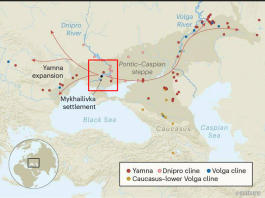
The book Royal Scythia, Greece, Kyiv Rus has little-known facts about the Scythians and offers a new perspective on their origin. It has been supported by recent genetic studies, by the way.
Speaking of genetics, it is notable that both in the Iliad and the Achilleid, Achilles is depicted as blond-haired.
Another book, the Cradle of Civilisations, takes a closer look at this topic among many others.
An important observation about the burial rites of both Patroclus and Achilles as described in the Iliad should be added to the books and the current discussion.
Patroclus’ Funeral Rites in The Iliad: Similarities with Funeral Rites of Kyiv Rus >