1976 December issue of The UNESCO Courier had the following passage:
“How Scythian horsemen of 2,500 years ago dressed, and the kind of equipment they used, is now known in the least detail. This knowledge came with the discovery of a remarkably preserved set of accoutrements buried with a 5th-century B.C. warrior in a Ukrainian tomb.
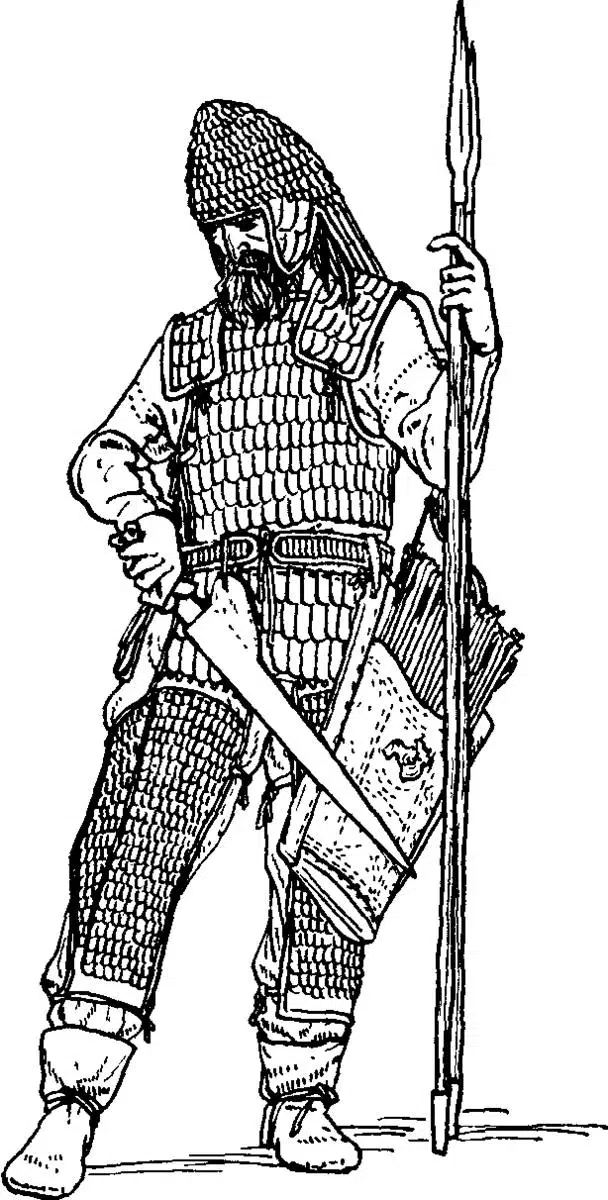
The conical helmet complete with earflaps, the leather back-piece covered with metal scales, the sword-belt of bronze plaques, and the breast-plate had all survived. Some of this equipment is depicted on a stone stele of the same period, as well as a long sword, a sheathed dagger, a rhyton (horn-shaped drinking cup), and a gorytus (quiver for bow and arrows). The warrior’s outfit also included leg armour laced to trousers which were tucked into flat-soled felt boots.”
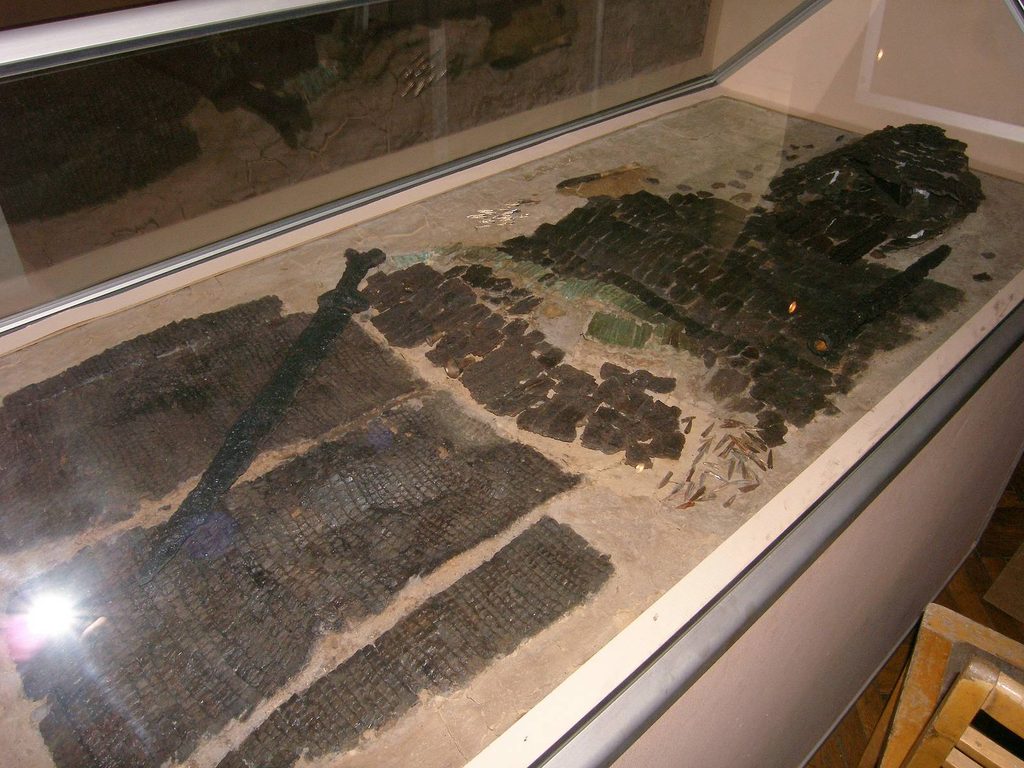
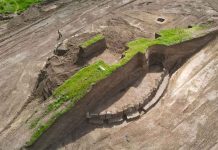
The UNESCO passage was referring to the 1967 discovery of a Scythian burial from the 5th century BC on the Ingul River near the village of Novorozanovka, Mykolaiv Oblast of Ukraine.
The body of a warrior lay on a spread-out scaly shell.

The armor was in the form of a shirt, falling down to the hips and covered with iron plates. Its length was 70 cm, width – 86 cm. The armor consisted of 15 horizontal rows of iron plates. The chest plates were sewn on in two layers.
Above the breastplate was a helmet, the leather base of which also had metal scales sewn onto it. Attached to the helmet were cheek guards and a nape guard.

Below the cuirass lay leather trousers, also covered in iron scales.
The presence of the scaled greaves—long rectangular blades protecting the legs up to the mid-calf or even the foot became another interesting feature of Scythian armor from Novorozanovka. Twelve examples of this armor are known to date. Sometimes these greaves were attached, each separately, directly to the body covering, as in the armor from Novorozanovka, where on the inside of the chest part of the armor, in the waist area, there were two bronze buttons for fastening the greaves.
The burial also contained a complete set of weapons. Attached to the combat belt on the right was a scabbard with a sword, and on the left, a quiver with arrows.
The quiver contained 200 arrows with socketed tips. To the left of the helmet lay two laurel-leaved spearheads with a slight flare at the bottom.
The protective suit from Novorozanovka served as a crucial archaeological reference standard for classifying 5th- to 4th-century BC Scythian armor technology.
It illustrates that prominent Scythian warriors relied on comprehensive scale protection rather than relying purely on mobility and ranged attacks.

Sergiy Skoryj from Institute of Archaeology of the National Academy of Sciences of Ukraine commented:
“Intact (or relatively intact) graves of Scythian heavily armed warriors are quite few.
The warrior from the barrow near Novorozanovka (body armor, leg guards, sword belt, helmet) was metal-clad from head to foot and, to a certain extent, can be considered to be a forerunner of medieval knighthood.
Another feature of the funeral rite was the placement of the body on the spread armor.
The heavily armed warriors buried in the barrows in various regions of Scythia are considered, in addition to men-at-arms, the “commanders”, persons of the “highest military strata of the clan aristocracy”, “Scythian tribal nobility”.
So who could be buried with magnificent sets of offensive weapons and metal armor? I cannot exclude that we are dealing with special persons of the Scythian army. They demonstrated their combat experience, their probable perfect mastery of the entire complex of weapons, personal courage (and possibly recklessness) on the side of various warring groups of both the Steppe Scythia and the Forest-Steppe area.
In other words, one can assume that in the nomadic milieu there were certain rudiments of mercenarism. Apparently, the “steppe wolves”, undoubtedly getting the fee for participation in the military actions, spent it primarily on the acquisition of effective weapons, which – especially the armor – was expensive. However, it is possible that in the circles of such “soldiers of fortune” there was a certain “code of honor” that did not encourage the demonstration of personal jewelry made of precious metals. One can assume the existence of certain collectives or teams in which these warriorrs were grouped for the duration of any military actions.”
The book ‘Royal Scythia, Greece, Kyiv Rus‘ provides a new perspective on Scythian culture and the amazing events that took place in the area of what is now Ukraine.