Watch it on YouTube: Scythian King who fought Philip II of Macedon: His burial in Ukraine
The gigantic, magnificent Scythian Royal Kurgan of Chertomlyk was 20 meters high, staggering 350 m in diameter, surrounded by a stone plinth, and a stone alley led up to it across the steppe.
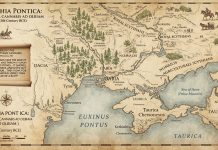
The kurgan was situated 22 km from the city of Nikopol on the right bank of the Dnieper River.
It was excavated in 1862 by Ivan Zabelin, who discovered in it the burial remains of a Scythian king and queen, their guards, horse skeletons, and a wealth of gold and silver ornaments and arms.
For a wide international audience, Chertomlyk Barrow was introduced by British archaeologist Professor Ellis Minns in his book ‘Scythians and Greeks’ published in 1913.
In his opinion, even in the class of large barrows, two barrows stood out – the Chertomlyk and Alexandropol ones.
Alexandropol kurgan, situated nearby, was one meter taller than Chertomlyk, but Chertomlyk exceeded Alexandropol in all other aspects.
For example, the vertical shaft leading to the central grave chamber at Chertomlyk ran under the black soil to a depth of 11 meters. It is the deepest level among all the kurgans.
At the corners of the shaft, there were four cave-like chambers.
King’s Chamber
In the south-west chamber, two skeletons lay side by side.
One wore a gold torque decorated with twelve figures of lions, while about its skull were twenty-nine rectangular gold plaques portraying a griffin that had decorated his headdress.
He had wide gold bracelets on his arms, gold rings on his fingers, and on the left side, there was a sword.
The other skeleton also wore a cast gold torque with lion terminals, a silver bracelet on his right arm, a gold ring on his finger, and a bronze belt at his waist. A sword was at his left side also, but the bones of the left arm up to the elbow were missing, according to Zabelin.
Queen’s Chamber
The northwest chamber contained a female burial, most likely of a Scythian Queen.
Her skeleton lay on the remains of a decayed wooden couch, 2 m. long and 1.5 m. wide, and bore traces of dark blue, light blue, green, and yellow paint.
On the queen’s forehead were a gold band decorated with a plant design, forty-nine plaques shaped like flowers and rosettes, and seven tiny buttons, also of gold.
On the sides of the skull, there were two gold earrings decorated with pendants on chains.
Around the head and the body were fifty-seven rectangular plaques that had adorned a purple shroud. On them were figures of goddesses with a Scythian on the one side and an altar on the other.
There was a solid gold torque with lion finials around her neck.
On the arms were broad gold bracelets with a rib down the middle, and on each finger a ring, one with a figure of a flying duck. Near the right hand was a bronze mirror with a bone handle.
In the same chamber on the floor near the couch was another skeleton, that of a young servant with her head towards the queen. On her arms were a bronze and an iron bracelet, at its side a knife, and somewhat lower a small pile of arrow-heads.
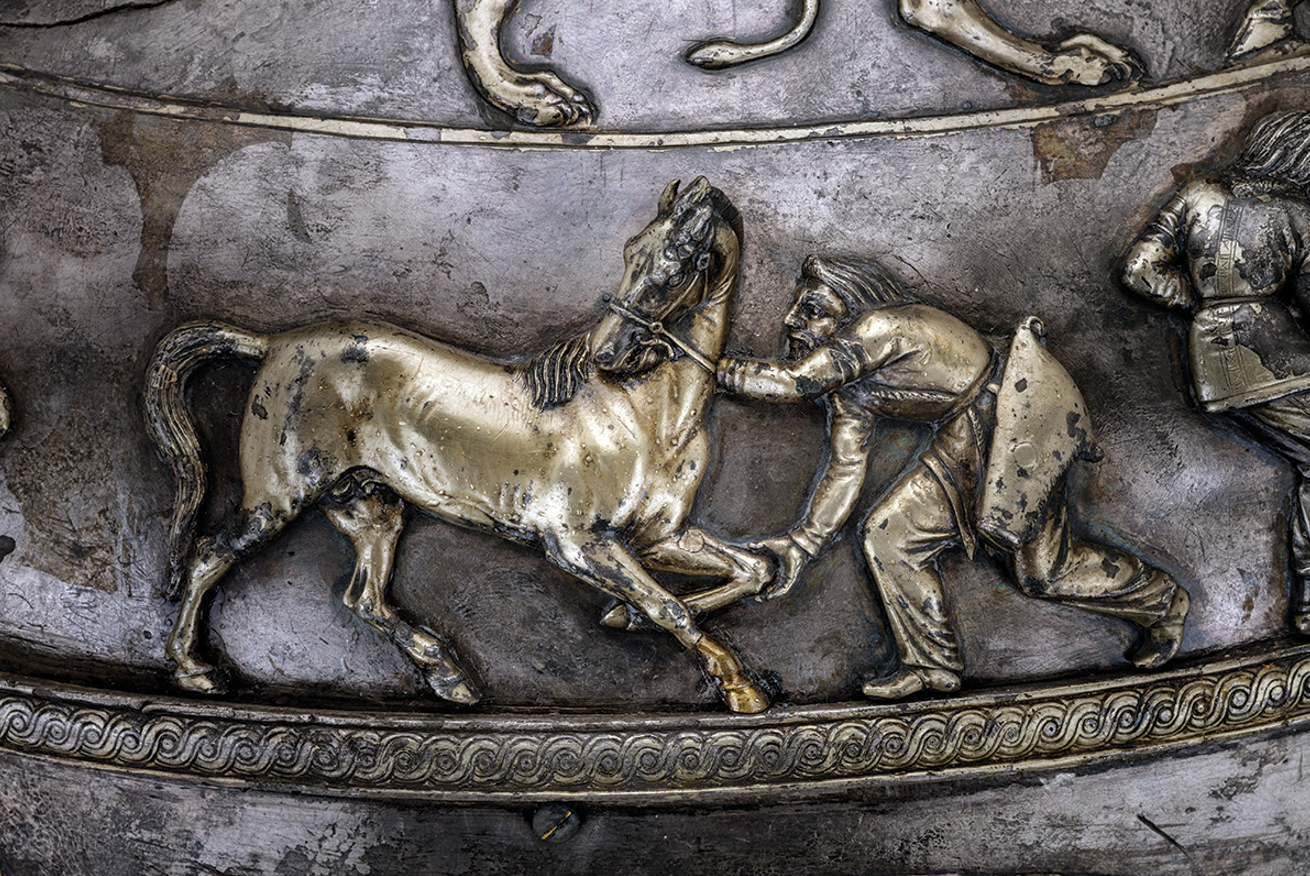
By the west wall stood the famous silver amphora showing scenes of Scythians taming horses, and a large silver dish with figured handles.
Beside the Queen’s chamber, a large oval underground chamber was found. In it, two bronze cauldrons covered with soot stood. The larger of the two contained horse bones, a skull, six ribs, and leg bones, and was decorated with six figures of goats around the rim, acting as handles.
Near the entrance to the Queen’s chamber, a bronze lamp with holders for six wicks was found, an indispensable item in the darkness of underground tombs.
Chamber # 3
The third large south-east chamber contained 350 arrows standing in rows against the wall, some of them still intact, with shafts about 70 cm. long.
Chamber # 4
In the fourth, north-west chamber at the entrance, there was the skeleton of a man with a plain bronze torque around its neck, with a gold pendant from an earring by his head and a gold spiral ring on one of the fingers of the right hand. At its left side was a knife with a bone handle and sixty-seven bronze arrowheads with traces of a leather quiver.
About his body were gold plaques, pole-tops, and spiral bands. All over the floor of the chamber were masses of gold plaques, pendants, beads, cylinders, tiny buttons, and other accessories for decorating clothing.
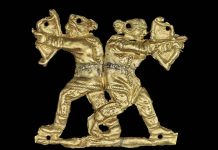
In all, about 2,500 pieces were collected from the floor. The most frequently depicted figures on the plaques were a bearded human head, a mythical animal called a hippocampus, a hare, Hercules strangling a lion, a griffin, a Gorgon’s head, little embossed triangles, flowers, rosettes, a Scythian fighting a griffin, and a helmeted Athena.
A silver spoon and two pendants shaped like sitting sphinxes were also found there.
Most Valuable Treasures
But the most valuable objects were found in the secret recesses of the main burial chamber with the King.
In one recess were two swords with gold hilts, one of which terminated in two magnificently sculptured ram heads. Its hilt was embossed with a scene of horsemen hunting goats.
It is believed that this remarkable hilt is of Persian origin from the Achaemenid era and dates to the fifth century BC.
But the blade of the sword was of Scythian manufacture. And it means that the hilt was reattached to a new blade locally at a later period.
In another recess was the gold mounting of a gorytos displaying the scenes of mythology.
A rectangular projection in the upper part of the gorytos shows a griffin struggling with a panther.
There was also the gold casing of a scabbard displaying a multi-figured battle scene.
On the side projection for fastening the sword, there is the figure of a griffin devouring a stag’s head.
Both scabbard and gorytos are similar in style and craftsmanship.
At Chertomlyk, under the mound and not far west of the human burial, there were horse burials, three large square pits roofed with logs, containing eleven horses.
In the first pit, the southernmost burial, were three horse skeletons; in the other two, four in each.
Horse & Grooms Burials
Five of the horses had bridle and saddle fittings of gold, six of silver.
Two graves near the horses contained single human skeletons of grooms with their heads pointing towards the horses.
One groom had a bronze torque covered with gold leaf around his neck, a gold earring with a pendant in the shape of a double-faced human head, and a spiral gold wire ring.
New Excavations
In 1979, new excavations at Chertomlyk began and lasted for seven years, until 1986.
In the northern part of the Kurgan, under the slabs of crepidoma or stone wall, the burial of a cupbearer was discovered. With him, there were 76 amphoras containing more than 1500 liters of wine.
New excavations revealed another important fact that Zabelin overlooked. It was established that the base of the mound was surrounded by a vertical stone wall about 2.5 m high, made of unprocessed, only slightly fitted, large stone slabs up to 2.5 m long.
The space between the stone wall and the edge of the mound’s earthen embankment was filled with smaller stones.
Who Was Buried at Chertomlyk?
Who was buried in such a grandiose kurgan? The scholars believe that it was the famous Scythian King Atheas, possibly the most powerful king of Scythia.
Atheas was famous for his love for horses and, despite his royal status, looked after them personally.
He was an excellent horse rider, and for that reason, on his coins, he is shown on horseback and with a bow in hand.
The reverse of the coin shows Heracles as the progenitor of Scythian kings.
Comparing the image of Atheas on his coin with the images of the Scythians bringing in horses on the Chertomlyk Vase, one can not help but wonder if it was not King Atheas portrayed on the Vase as well.
It seems logical to assume that such a masterpiece as the Chertomlyk vase would represent someone famous and not an average Scythian.
King Atheas died at the age of 90 in the battle against Philip of Macedon, the father of Alexander the Great, in 339 BC.
Sadly, the outcome of that battle was falsified.
The book Cradle of Civilisations proves it and tells the story of the relationship between Scythian and Macedonian kings from a new perspective.
The book Royal Scythia, Greece, Kyiv Rus takes a closer look at the Chertomlyk Vase and the Chertomlyk Gorytos Overlay.