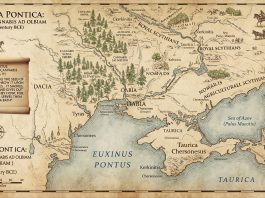



One of the largest Scythian Royal kurgans, the 18 meter-high Solokha kurgan in the Zaporizhzhia region of Ukraine, on the left bank of the Dnieper River, was excavated in 1913.


The barrow concealed two vaults. The first vault, in which a woman of high birth was buried, had been plundered a long time ago, and all that was left were the remains of two horses in rich attire, old dress ornaments, a gold needle, and two vessels – one silver, the other bronze.
The second vault contained the body of either a Scythian king or a Scythian warlord, and it had not been plundered.
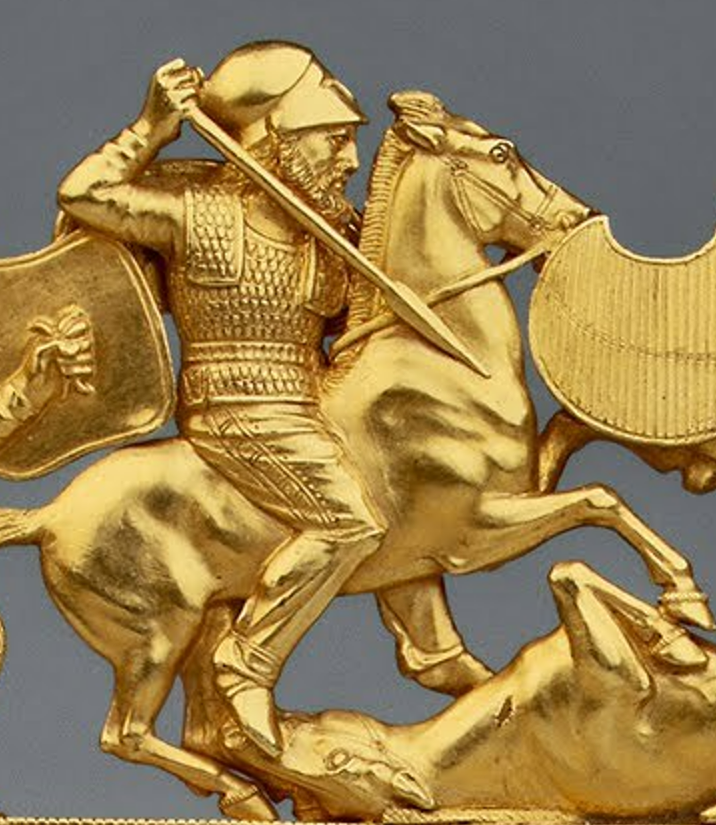
To the left of the chief’s head was a bronze helmet of Corinthian type. The extraordinary gold comb with the sculptured figures of the fighting Scythians was next to the helmet.
Gold rings and bracelets adorned the arms of the king, and around his neck was a large gold rigid neck ring called a gryvna or torque. The splendor of the attire, embroidered with gold plaques, was further heightened by an iron sword in a gold sheath and a delicately wrought gold phiale.
That sword gave its name to the whole series of Scythian swords. The Solokha-type swords are characterized by their claw-like pommels.
Silver-plated bow-and-arrow holder known as gorytos, next to the Scythian warlord, contained 180 very sharp bronze arrowheads.
The composition on the silver cover depicts a clash of five warriors, where two elder Scythian horse riders fight three young footmen. Modern scholars study the details of Scythian weapons, such as the axe, dagger, and sword, as depicted on this silver cover. This gorytos, just like a golden comb mentioned earlier, is also considered a masterpiece of Scythian toreutics.
Speaking of weapons, it is worth noting that along the chief’s right arm lay a six-winged bronze mace on a wooden handle, bound in copper at the bottom.
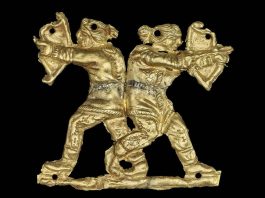
Starting from the waist down, there were 300 gold plates that decorated the trousers and kaftan of the deceased. The gold plates portrayed griffins, lions, and the Scythians.
More than 130 gold plates found alongside the legs of the deceased had the same image of two Scythians drinking from one rhyton. The scholars interpret the scene as the Scythian Brotherhood Ritual described by Herodotus.
The silver vessel with two hunting scenes in relief stood to the right of the Scythian warlord. In the first scene, two horse riders hunt a lion. The scholars think that the two dogs portrayed in it are of the “primitive greyhound” breed.
In the second scene, two horse riders hunt what appears to be a lioness with the goat’s horns, but it is possible that it is some fantastic animal.
A weapon-bearer of the Scythian warrior-chief, his servant, five horses, and a stableman were found in the adjacent compartments.
Historians believe that it was Scythian King Octamacades who was buried in Solokha Kurgan. The King is known to history thanks to Herodotus, who described him as the ruler who killed his brother Skyles for betraying the Scythian faith for the sake of Greek beliefs.
The archaeologists observed that the bronze helmet found on the head of the Scythian warlord buried in the Solokha kurgan resembled the helmet on the head of the horse rider on the Solokha comb. A short-sleeved tunic covered with iron scales resembling the one on the horse rider was found at the entrance to the chamber. There were also bronze grieves nearby.
Adding to these three coincidences the fact that the comb was placed near the head of the deceased, it seems logical to conjecture that it was most likely the very Scythian warlord represented as the horse rider on the comb who was buried in the second Solokha chamber.
In the next video, we are going to take a closer look at each of the figures sculptured on the comb. Specific attention will be devoted to their faces. Subscribe to the channel not to miss the premiere.
The book ‘Royal Scythia, Greece, Kyiv Rus’ offers little-known information about other famous kurgans discovered in Ukraine.