


When one searches for the boundaries of Scythia, one sees many different maps with boundaries stretching all the way to India and Afghanistan. While it is true that groups of Scythians moved east and even established the Indo-Scythian Kingdom in the first century B.C., those maps are still misleading. They fail to mention the exact boundaries of Scythia, which were provided by Herodotus. And here is what the Father of History wrote in his famed Histories:


“Scythia is a quadrangle, two sides of which reach the sea, and the line running inland is the same length as the one that stretches along the sea. Thus, from the Ister to the Borysthenes is a ten-day journey, and the same from Borysthenes to the Meotis. On the other side, from the sea inland to the Melanchlaeni, who live above the Scythians, is a 20-day journey. I estimate a day’s journey at 200 stadia. Thus, Scythia has the cross-measurement of 4,000 stadia. Those straight sides that run inland are of the same length. Such is the size of this country.”
There were the Delphic stade, the Attic stade, and the Olympic stade at the time. Herodotus most likely used the Attic stade of 177.6 meters. In such a case, a day’s journey of 20 stades would be equal to 35.5 km, which is consistent with the average length of a typical day’s horse journey.
We can try to verify Herodotus’s definition of the southern, coastal side of the Scythian square. It should be a ten-day journey from the Danube to the Dnieper. If we draw a line along the coast, not right at the edge, but 30-40 km from the sea to avoid crossing numerous estuaries, then we get 350 km. It is a complete match with Herodotus’s data because the distance from the Ister to the Borysthenes is covered in 10 days at 35 km per day.
What about the other 350 km of the southern side of the Scythian Square? There have been several attempts to envision its direction. British Academic Ellis Minns, in his book published in 1913, viewed the second part of the line after the Dnieper River, going via Taurika-Crimea all the way to Pantikapaeum-Kerch. Many other historians agreed with him.
Others pointed out that the semi-island had its own Tauro-Scythian kingdom and thus it should not be viewed as part of Scythia proper. In such a case, after the Dnieper estuary, the southern border should extend towards the northern part of the Azov Sea, ending approximately in the area of present-day Mariupol.
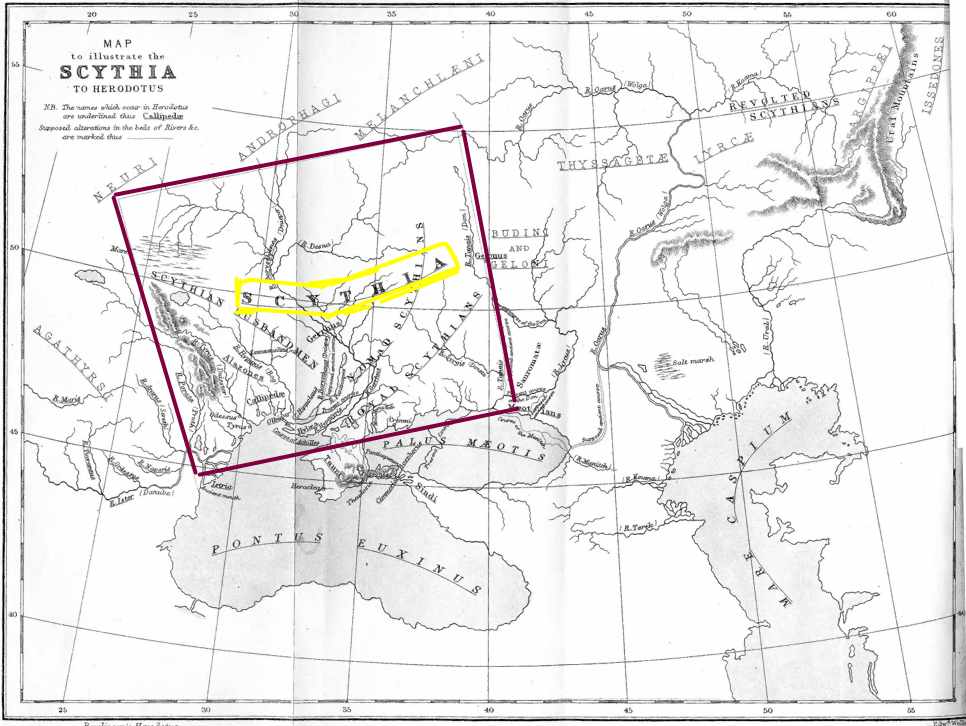
Another prominent British scholar and writer of the 19th century, George Rawlinson, in his translation of Histories of Herodotus, held a similar view, which is reflected in the following map.
Modern scholars think that the northern border of Scythia ran roughly from the Pripyat River, through Chernihiv to Kharkiv, and toward Voronezh.
There may be some minor corrections to the offered scheme, but the most important comment was written by Herodotus 2500 years ago: Beyond the Tanais River, there is no longer Scythia.
Every map potraying Scythian realm should mention the fact that the Don River was the eastern border of Scythia.
One other important thing Herodotus mentioned while describing the western border of Scythia. He wrote that from the Dabube began Old Scythia. And this fact raises some questions.
For example, how old could that Scythia be from the point of view of the historian of the 5th century B.C.? Did that Old Scythia exist in that area 500 years before Herodotus?
Curiously, according to Scythian genealogical legend recorded by Herodotus, the Scythians tied their origin to the Dniper River, and not to Persia.
The book “Royal Scythia, Greece, Kyiv Roos” provides more food for thought in this regard.