

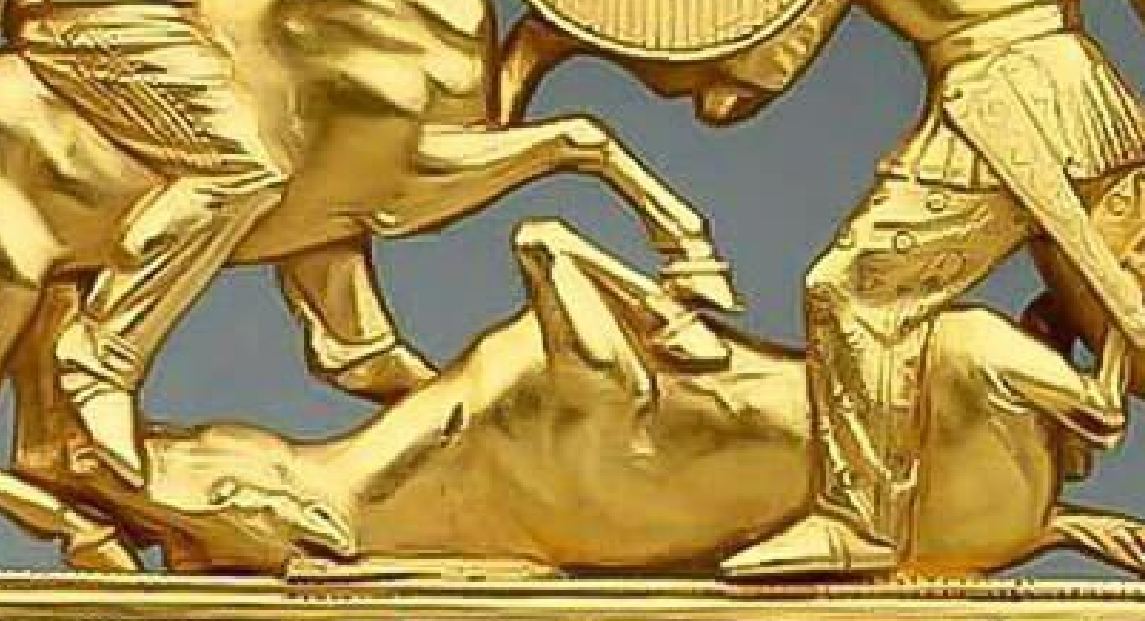

Scythian artifacts offer a unique opportunity to explore the details of Scythian attire and weapons. For example, let’s take a closer look at one of the most famous examples of Scythian art, the Golden Comb with Battle Scene from Solokha Royal Barrow in central Ukraine.


The length of the comb is 12.3cm, width is 10.3. The Length of the teeth is 6.5cm. Relief thickness is 0.7cm. Weight 294 grams.
It means that the details you see in the pictures are visible only under a strong magnifying glass. How the comb was made with such detail 2500 years ago still puzzles scholars.
At the center of the composition is a horseman attacking a dismounted enemy, whose wounded horse has fallen backward. A foot soldier rushes to the horseman’s aid. The victorious horseman holds a raised spear in his right hand and clutches the reins in his lowered left.
On his head is a so-called Corinthian helmet. Over his shirt, he wears a short, scaled, probably metal, breastplate with shoulder guards and a scaled belt.
Wide trousers are decorated on the side with a vertical stripe featuring a pattern of crosses separated by two strokes. Knemids are worn over the trousers and tied at the ankle. A gorytos with arrows is on the left side of the waist.
The warrior behind is dressed in a belted, sleeveless caftan with elongated flaps at the front, made of thick, dense material (apparently fur or leather), trimmed with fur, with a fur hood or triangular collar on the back.
The clothing is covered with patterns: the caftan is decorated with circles, the trousers with crosses; the back of the caftan and the sides of the trousers have longitudinal stripes.
The caftan is cinched with the same scaled belt as the rider and his opponent. The footwear on the side figures is the same as that of the rider.
The dismounted warrior wears a pointed Thracian helmet. He wears the same attire as a horseman, over a shirt: a smooth cuirass with shoulder pads, probably leather, covered with scales on the chest; its edges at the hips are ruffled, forming regular, flat folds.
The trousers are decorated with carved circles, and on the sides is a vertical band of crosses, also framed by carved lines.
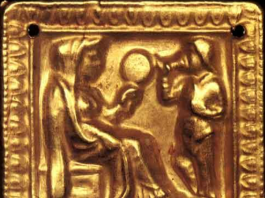
As for the king buried in the kurgan near whom the comb was found. Starting from the waist down, there were 300 gold plates that decorated the trousers and kaftan of the deceased. The gold plates portrayed griffins, lions, and the Scythians.
More than 130 gold plates found alongside the legs of the deceased had the same image of two Scythians drinking from one rhyton. The scholars interpret the scene as the Scythian Brotherhood Ritual described by Herodotus.
Several videos about the Kurgan and discoveries in it are available at the YouTube channel already.
The book ‘Royal Scythia, Greece, Kyiv Rus’ has little-known information about other famous kurgans discovered in Ukraine.