Gladkivshchina Kurgan #2
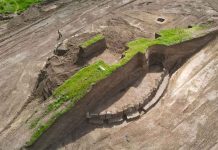
In 1982, researchers explored a burial site unique in its composition and state of preservation near the village of Gladkovshchina in central Ukraine, between the Dnieper and its tributary, the Supa River.
Kurgan No. 2 was part of a group of five mounds from the Bronze Age and Scythian times.
At the time of excavation, the mound was 0.85 meters high and 42 meters in diameter.
The original mound measured 25 meters in diameter, and its reconstructed height was 4 meters.
A continuous ring ditch surrounded the primary embankment. Its internal diameter was 32 meters, its width was from 1 to 1.5 meters, and its depth was 1 meter.
Armor Discovery
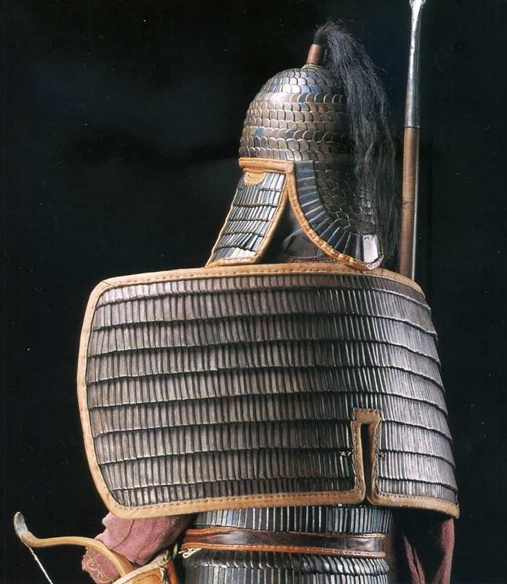
At the bottom of the burial chamber, on an iron plate shield, a similarly unfolded armored shirt with short sleeves, a wide protective belt, and trousers, with the leather base facing upward and spread out on a grass mat, lay the skeleton of a man aged 45-55 years.
An iron-plated helmet lay at his head.
The deceased was buried with his head facing west.
At the buried man’s left hand, on his trousers, lay a short iron sword and a set of bronze arrowheads.
In the corner of the chamber lay three iron spearheads.
Due to the exceptional importance of the armour discovered in the burial, it was taken as individual monolithic blocks and, along with other equipment, transferred to the Central Scientific Research and Restoration Workshops of the Ministry of Culture of Ukraine.
Restoration
Professor Minzhulin, head of the metal restoration sector, carried out cleaning and restoration work, as well as laboratory analyses of the organic material remains.
The process took him and his team of scientists six long years to complete.
In his book, Restoration of Metal Works, published in Kyiv in 1994, Doctor Minzhulin described the process that the armor from Gladkivshchina underwent in his laboratory.
It was established that the armour was built on a durable leather foundation, onto which rows of iron scale plates and elongated bronze plates were sewn.
140 days with a 10-hour workday of continuous work was necessary just to make a set of plates for protective armor.
The metal component of all parts of one such armor, as well as a shield and helmet, consisted of almost a dozen types of plates of various sizes.
They were cut from 0.6 mm thick sheet metal, and it took 33 working days to make them.
The total weight of the plates equalled 13.5 kg.
Each of the 3,300 plates had to have three to five, or even more, holes made by hand with a punch.
They were needed to sew the plates onto the leather base in a specific order.
Sometimes the craftsman had to use up to three needles at the same time to attach the plates in the required sequence.
The entire work, including sewing on the straps and ties, took 213 light days.
This figure is impressive, but it can hardly be considered definitive. If only because ancient ironsmiths did not use rolling, they had to forge each plate separately.
In addition, the thin plates had to be hardened to increase strength.
Therefore, it would be worth taking these points into account in the labor costs.
It took another 42 days to make other equipment and weapons, from sewing the boots and trousers to the sword and scabbard.
That is, the total time spent on the set was 255 days.
Such work required elementary cooperation, the use of the labor of numerous assistants and journeymen; in short, a team of 12–15 workers.
Such a group could spend from 17 to 22 working days on equipping a “Scythian knight.”
Scythian Division of Labor
In order for such production to operate at full capacity, raw material industries had to be developed.
Just one set of armor is 15.5 kg of iron, 0.1 kg of bronze, 6 square meters of leather, not counting beeswax, lard, threads, fabrics, charcoal for the furnace and many other things necessary for production.
The Scythian weapons workshops had to work non-stop to adequately supply everyone who could order something like this.
At the same time, the natural loss of weapons also had to be replenished annually.
After all, every deceased warrior took with him to the afterlife the best armor and weapons.
And this is without taking into account the losses on the battlefield, routine repairs, and so on.
The warrior had to be armed – he had to have a sword, spears, darts, a battle axe, and finally a bow, as well as a bunch of other equipment needed on the campaign.
The creation of the above-listed types of weapons also required specialization — for example, in the manufacture of swords and bows, as the most technologically complex products.
Cavalryman
The Scythians wore this armour over clothing that consisted of a linen jacket and trousers tucked into short boots.
It was established that the complete armour from Gladkivshchina weighed approximately 23 kg.
Such impressive weight made scholars conclude that the armor was made for Scythian cavalrymen.
Shield
The shield from the mound seems to confirm the supposition.
According to scientists, shields that were wider than they were high, in contrast to the oval oblong shields of infantrymen, were part of cavalry armor.
They were worn in a horizontal position behind the back, similar to the image on the gold crest from the Solokh mound.
There is a video on this channel devoted to that famous Scythian artifact.
To check the theory, the armor was tested in real life.
When testing the armor on a rider, it was found that a shield with a leather-based armor coating, rigidly attached to the back of the shirt at two points, as well as to the shoulders and arms with straps, retains its shape, is sufficiently flexible, and does not hinder movement.
As the model performed various movements, it was noticed that the slit in the lower part of the shield was constantly in motion. It narrowed at the bottom and widened, which gave it flexibility. Apparently, the slit was a backup compensator for movement.
The protective functions of shields of this type are very effective, because the warrior could easily protect his arms, torso, and face by moving his shoulder joint, and at the same time could freely wield his weapon and control his horse.
A full-scale reconstruction of the entire weapons complex showed that the Scythian army had a certain contingent of heavily armed horsemen, whose armor was not inferior in terms of protection to the equipment of medieval knights two thousand years later.
Persian Campaign
Such an advanced form of the Gladkivshchina armor dating to the fifth century BC makes scholars believe that a similar form of armor existed in Scythia in the sixth century BC already.
And it means that Scythian heavy-armed cavalry existed and opposed the Persian invasion of Darius the Great into Scythia in 513 BC.
The book ‘Royal Scythia, Greece, Kyiv Rus’ has the details of that campaign. The book also has little-known details about the famous Scythian bow and the way it was perfected.