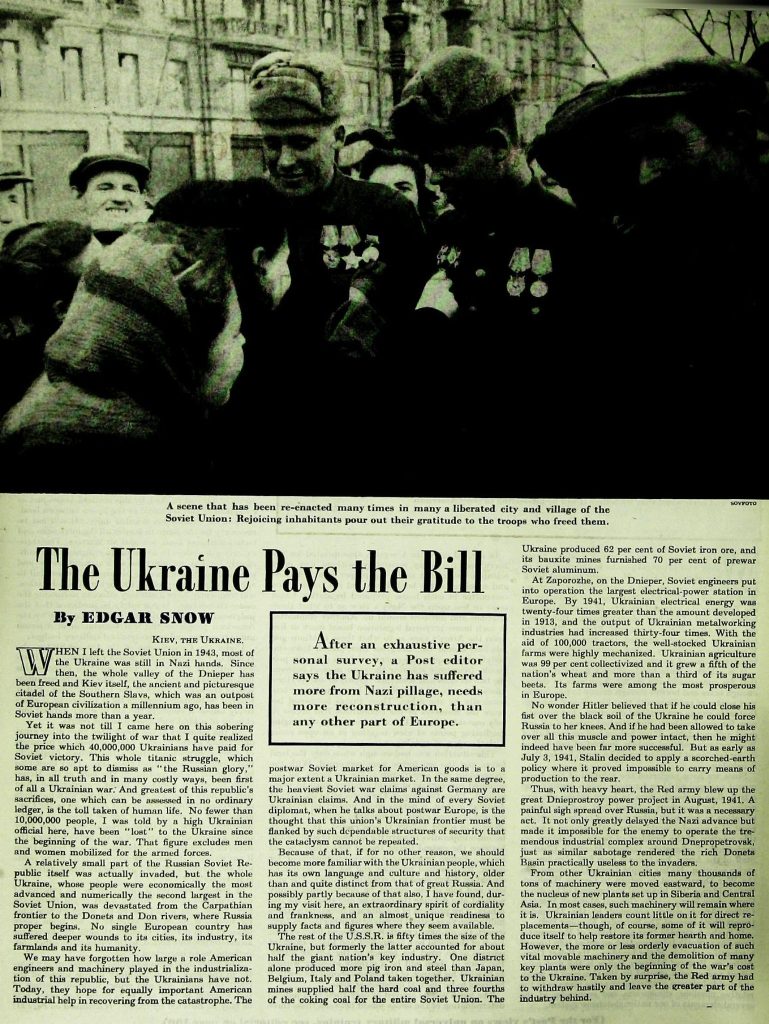
Saturday Evening Post on January 27, 1945
UKRAINE PAYS THE BILL
“After an exhaustive personal survey, a Post editor says Ukraine has suffered more from Nazi pillage and needs more reconstruction than any other part of Europe.”
KYIV, UKRAINE. WHEN I left the Soviet Union in 1943, most of Ukraine was still in Nazi hands. Since then, the whole volley of the Dnieper has been freed and Kyiv itself, the ancient and picturesque citadel of the Southern Slavs, which was an outpost of European civilization a millennium ago, has been in Soviet hands more than a year.
Yet it was not till I came here on this sobering journey into the twilight of war that I quite realized the price which 40,000,000 Ukrainians have paid for Soviet victory. This whole titanic struggle, which some are so apt to dismiss as “the Russian glory,” has, in all truth and in many costly ways, been first of all a Ukrainian war: And greatest of this republic’s sacrifices, one which can be assessed in no ordinary ledger, is the toll taken of human life. No fewer than 10,000,000 people, I was told by a high Ukrainian official here, have been “lost” to Ukraine since the beginning of the war. That figure excludes men and women mobilized for the armed forces.
A relatively small part of the Russian Soviet Republic itself was actually invaded, but the whole Ukraine, whose people were economically the most advanced and numerically the second largest in the Soviet Union, was devastated from the Carpathian frontier to the Donets and Don rivers, where Russia proper begins. No single European country has suffered deeper wounds to its cities, its industry, its farmlands, and its humanity.
We may have forgotten how large a role American engineers and machinery played in the industrialization of this republic, but the Ukrainians have not. Today, they hope for equally important American industrial help in recovering from the catastrophe. The postwar Soviet market for American goods is, to a major extent, a Ukrainian market. In the same degree, the heaviest Soviet war claims against Germany are Ukrainian claims. And in the mind of every Soviet diplomat, when he talks about postwar Europe, is the thought that this union’s Ukrainian frontier must be flanked by such dependable structures of security that the cataclysm cannot be repeated. Because of that, if for no other reason, we should become more familiar with the Ukrainian people, who have their own language and culture and history, older than and quite distinct from that of great Russia. And possibly partly because of that also, I have found, during my visit here, an extraordinary spirit of cordiality and frankness, and an almost unique readiness to supply facts and figures where they seem available. The rest of the U.S.S.R. is fifty times the size of Ukraine, but formerly the latter accounted for about half the giant nation’s key industry. One district alone produced more pig iron and steel than Japan, Belgium, Italy, and Poland taken together. Ukrainian mines supplied half the hard coal and three-fourths of the coking coal for the entire Soviet Union.
Ukraine produced 62 per cent of Soviet iron ore, and its bauxite mines furnished 70 per cent of prewar Soviet aluminum. At Zaporizhzhia, on the Dnieper, Soviet engineers put into operation the largest electrical power station in Europe. By 1941, Ukrainian electrical energy was twenty-four times greater than the amount developed in 1913, and the output of Ukrainian metalworking industries had increased thirty-four times.
With the aid of 100,000 tractors, the well-stocked Ukrainian farms were highly mechanized. Ukrainian agriculture was 99 per cent collectivized, and it grew a fifth of the nation’s wheat and more than a third of its sugar beets. Its farms were among the most prosperous in Europe.
No wonder Hitler believed that if he could close his fist over the black soil of Ukraine, he could force Russia to her knees. And if he had been allowed to take over all this muscle and power intact, then he might indeed have been far more successful. But as early as July 3, 1941, Stalin decided to apply a scorched-earth policy, where it proved impossible to carry means of production to the rear. Thus, with a heavy heart, the Red army blew up the great Dnieprostroy power project in August, 1941. A painful sigh spread over Russia, but it was a necessary act. It not only gently delayed the Nazi advance but made it impossible for the enemy to operate the tremendous industrial complex around Dnepropetrovsk, just as similar sabotage rendered the rich Donets Basin practically useless to the invaders.
From other Ukrainian cities, many thousands of tons of machinery were moved eastward, to become the nucleus of new plants set up in Siberia and Central Asia. In most cases, such machinery will remain where it is. Ukrainian leaders count little on it for direct replacements—though, of course, some of it will reproduce itself to help restore its former hearth and home. However, the more or less orderly evacuation of such vital movable machinery and the demolition of many key plants were only the beginning of the war’s cost to Ukraine. Taken by surprise, the Red army had to withdraw hastily and leave the greater part of the industry behind.
From all occupied areas, according to Soviet figures, the government managed to evacuate, by heroic measures, a total of 1,200,000 railway carloads of industrial equipment—of which only a part came from Ukraine. Compared with the Nazi pillage during their two years’ occupation, the Russians saved a modest amount. Cruel and finally fatal blows were delivered by the invaders to the basis of Ukrainian industry and mechanized agriculture late in 1943 and 1944. For example, here in Kyiv, only one of half a dozen great cities of Ukraine, the Nazis not only carried off all the machinery but stripped every house and office of its last piece of furniture. The deputy mayor of Kyiv estimates that about 250,000 cars were utilized in that operation alone.
Standing in the midst of the ruins of the great Bolshevik machine-building plant here, the engineer-in-chief told me that it would cost 20,000,000 gold rubles to replace the lost machinery in this one spot. Incidentally, he thought it would take 2600 workmen from two to three years to clear away the debris and rebuild the structure. I found that 8000 Russian prisoners of war had been employed at the plant, for two months prior to the Nazi retreat, solely in dismantling machinery and packing it for shipment to Germany, where Hitler was desperately attempting to restore his own bomb-ravaged war industries. Multiply that by hundreds, by thousands, and you may get an idea of how much labor, how much time and thought, and how many million freight cars the Germans devoted to the denudation of Ukraine. Commissions are still adding up the total damage. But meanwhile, Vladimir Nikolaievich Valuyev, the able and plain-speaking young chairman of the Ukrainian Gosplan, or State Planning Commission, let me sample a few rough estimates. For instance, in the towns alone, about 22.000,000 square meters of living space have been destroyed. In Poltava, a typical rural district, about 100,000 peasant homes were destroyed out of an original total of 362,000. In a single industry-agrarian region, Kamenets Podolsk, 470,000 civilians were killed, and 103,000 were deported to Germany, out of an original 2,000,000 population; 562 villages were destroyed, 18,000 peasant homes and 6000 kolkhoz buildings were destroyed, and 310,000 horses and cattle and 1700 tractors were carried off. One Soviet authority stated that at least 50 per cent of all the means of livelihood and production were gone. In the ca. of Dnepropetrovsk alone, the replacement coat in such terms will run to 350,000,000 American dollars.
Pierre Cot, the Frenchman who made an extensive tour of the liberated areas, gave me 250,000,000,000 gold rubles, or $50,000,000,000, as his estimate of the damage done during the war. That includes only physical plant, of course. If it is near the truth, then one might venture to guess that the Ukrainian part of it will be somewhere between $30,000,000,000 and $40,000,000,000. And the mechanical equipment needed to restore it might then cost something like $10,-000,000,000.
About half of Ukraine, lying on the west bank of the Dnieper, was liberated only in the spring and summer offensives of 1944, but the greater industrial and farming areas have now been in Soviet hands again since late in 1943. What had been accomplished, I wanted to know, in a year’s effort at recovery. I took the question to several Ukrainian authorities and made spot investigations at a number of farms and factories. I did not find anybody minimizing the tasks or inclined
to exaggerate what had been done. I sensed a good deal of impatience with clumsy party propaganda that has attempted to convince the outside world that full-scale “reconstruction” has already begun. Everywhere there was emphasis on the complexity of the difficulties, the volume of work to be done. Despite that, what emerged out of my inquiry, and what is perhaps the main message of this report, is something else. It is likely that Ukraine will recover its former position more quickly than any other war-torn country of Europe. It is that not long after industrial production has been fully restored here, the Soviet Union may be much farther along the road toward abundance than it was before 1941.
But right now there is this bleak portrait of the present. There is, first of all, the labor shortage. The millions of Ukrainians taken to Germany included many of the nation’s best workers. Some went eastward—and many will remain there. In one factory that I visited, only 220 workers out of an original 6000 were back at work. In another, thirty answered to the foreman’s roll call of 700. In the small industries and workshops, most of the workers were Jews. A million and a half Ukrainian Jews once lived here, but little trace of them now remains. On the farms, there are relatively fewer men than in towns. At one collective that I visited, there had reappeared 264 out of a prewar total of 700 workers, but only fifteen men were back, out of an original 234. A second farm had supported 2035 peasants before the war. Now it mustered only forty-five able-bodied men out of its former 1400. A different way of saying the same thing is that out of 3900 tractor drivers trained here this year, 3500 were women. The dean of the Ukrainian University, many of whose buildings were blown up by the Nazis before they left, told me he has 2300 students back in the improvised class-rooms. Four hundred are males. “The men only have to fight,” said a Russian feminist—rather a rara avis (rare bird) in this country, by the way—whom I met on the train. “We have to feed the army and clothe it and nurse it and arm it and protect the next generation all at once. Now we have to pick up the pieces here and rebuild the place and provide the future with new sons and daughters. They say this is a man’s war, but there has never in history been anything that was more of a woman’s war. No wonder we hate war more than men do.”
Women are doing most of the salvaging—and the amount of labor involved in cleaning up after a demolition is seldom appreciated. At one former factory, I watched some hundreds of women and boys working with their bare hands—there are few tools or wheels left—trying to clear the debris from a corner of the plant. It seemed to me that they were engaged on a lifetime task.
“You see, it doesn’t work out like the reverse moving pictures,” dourly remarked the engineer with me. “Now, if some smart lad would just invent a hooch to put a building together again —”
But even if good labor and materials were available, reconstruction would be severely hampered by lack of other means. Transport, for instance. Formerly, Ukrainian government institutions owned tens of thousands of trucks; today, they have but a few thousand broken-down lorries. Railways and bridges have been restored only to the minimum necessary to maintain military supply. In farm work, the shortage is also severe. Seventy per cent of the tractors and 80 per cent of the horses are missing. Beyond that, the lack of materials of all kinds is acute and, when available, they go first to the army if they are of any military value. Ukrainian electrical-power, coal, iron, steel, and chemical industries were destroyed almost totally, and the major work of restoration has hardly begun. One reason is that a very large part of the Ukrainian enterprise will be immobilized until the great dams on the Dnieper are rebuilt and until the Donbas mines are working again. Some rosy pictures have been painted abroad about that. But the fact is that Dnieprostroy is still a ruin. Denying over-optimistic reports about progress in the Donbas, too, Ukrainian officials tell me that, so far, production there is insignificant.
“Don’t forget that the Donbas hasn’t been worked for three years, and that it was ninety-seven per cent mechanized,” I was reminded by the Gosplan Chief Valuyev, “and all that mechanization was lost. The mines are still flooded with three hundred and fifty million cubic meters of water, and it keeps piling in at the rate of thirty-five million cubic meters every day. Our pumps aren’t big enough for the job. About all we can do is to hold the water at its present level. We won’t be able to clear the mines again until we can import from America the big pumps needed—likely not till after the war.”
Few machine tools are being turned out, and few tools means little new machinery. One example: the prewar Kharkiv tractor plant had 1100 machine tools and made 100 tractors a day. Now the same plant has 100 machine tools and makes three tractors a day. The “restored” plant in demolished Stalingrad also can assemble and repair, but cannot manufacture new machines. Why doesn’t the needed machinery arrive from the east—from all that new industrial plant in Siberia and Asia? The answer I get is that the first priority is still the defeat of Germany. Secondly, there is the demand for equipment to complete planned industry now becoming a permanent fixture in the east. Major help in many lines can be expected only after the war.
For all that, here is one kernel of my story: these Ukrainians have in a single year, using little but their hands and feet, it seems, turned their country from a complete liability back into an important producer of the Soviet Union. Here are the skeletal facts of the achievement—the triumphs, largely, of women and children and old men coming out of holes in the ground, after three years of terror and war.
Foremost revelation is the amazing 1944 harvest. Big areas were still battle-fields, but everything possible was planted, including fields not yet demined—and some peasants paid with their lives for that. Everything that would pull a plow or a cultivator, a har-row or a reaper, was utilized. Around Kyiv, 40,000 cows were harnessed up. All citizens, including part of the army, were mobilized to bring in the harvest. Seventy per cent of the crop was reaped by sickle and scythe. When it finally was milled down, by late October, the Ukrainian wheat yield was found to be three fourths of a normal prewar harvest, covering more than 60 per cent of the area sown in 1940. So this winter nobody need starve in Ukraine. Secondly, while Ukrainian workmen stayed in the east, Ukrainian cattlemen and collective chiefs drove back such stock they had earlier managed to evacuate. These returning migrants were thinly spread across the republic. Result, by the end of 1944: nearly 80 per cent of the Ukrainian collectives had already restored some kind of cattle-breeding sections; half of them had pigs again, a third had sheep, two-thirds had poultry.
Last fall, the Ukrainian commissariat of agriculture began to mobilize farmers to rebuild their houses. By November, more than 100,000 had been erected. Throughout the relatively mild Ukrainian winter, this work continues.
“We lacked tools, nails, glass, and transport,” explained the vice-chairman of the region, who stood by my side. I watched work proceeding on one of the 500 rebuilding projects in the province of Kyiv.
“We lack all kinds of finished materials, but we have an abundance of good timber everywhere, we have some fine old carpenters among the peasants, we have technique, and our people are crying for houses.” Combining those advantages and hurdling the obstacles, the commissariat went ahead with plans immediately. The state set up model housing projects where peasants could come, look, and learn how to build the same thing in their village. The models are five or six rooms in the old New England style, put together joint by joint, made from top to bottom with little but an ax and a rip saw, covered with thick grass roofs and requiring very few nails. The peasants are allowed to cut the timber they need from the state forests and are helped with transport. Any home builder is entitled to a 10,000-ruble loan from the government without interest, to pay for labor, materials, and furniture.
By the new technique, fifteen hands can erect one house in a month. “How soon do you expect to get a roof over the heads of all your people?” I asked Starchenko, the cheerful, round-faced vice chairman of the government. He listed all the impediments to rapid achievement. Then, grinning wryly, he replied, “Given a little luck, we ought to have a roof for everybody in a year and a half or, at most, two years.” It would be wrong to leave the impression that industry isn’t producing here, too; though most of the restored floor space you see seems to be empty and waiting for machinery—American machinery, the Ukrainian at your side often hastens to add. For one thing, about a third of all the prewar industrial-power facilities of the republic are back in use—a fine accomplishment. Also, by the end of 1944, twenty-two mines were drained in the Kryvyi Rih, thirty-seven open-hearth furnaces were restored, twenty-three steel-rolling mills had been rehabilitated, and in excess of 500 workings of coal mines were operating.
In terms of prewar output, their significance was still negligible, according to Valuyev, but I happen to know that is more blast furnaces than the Chungking government of China has built in six years.
Kyiv’s industry produced in 1944 about an eighth of its 1940 output. Enough light industry was restored elsewhere to enable state planners to count on a 1945 production of around 15 to 20 per cent of 1940. But even in 1945, 85 per cent of the emphasis will be on repair and construction of buildings, only 15 per cent on machinery.
This is becoming a small book, yet there are some important things still to be said. One of them is that people who are running the economy here think that, despite the good harvest, the bread ration can’t be increased much in 1945. The army has to be fed for a long time yet and the cities will be filling up with bread eaters needed to rebuild. Half a million souls are back in Kyiv already.
Another thing is that the average Russian will probably get little more sugar for a couple more years yet. By the high-priority concentration method, the Ukrainian beet-sugar industry could be got back to normal earlier, but it is not yet on the cards stacked up in the offices of the state planning commission.
Despite such dark patches on the canvas, or perhaps because of them, the astute group of young men and women who are putting this place together again today expect Ukrainian agriculture to be back on both feet in two to three years. They believe both heavy and light industry will recover the 1940 level of production within three to five years after the end of the war. Even the Donbas and Dnieprostroy will be restored within that time. Cities will take longer to reconstruct. All kinds of new standards are being enforced; they will be more beautiful and more efficient, we are told. But cities, too, will be rebuilt in eight to ten years with the help of German prisoners. About the only thing these young people cannot predict with reasonable confidence is the probable recovery of the prewar population.
As I talked to thirty-six-year-old Valuyev, who has spent all his adult life as an economic planner, he suddenly produced from his desk the translation of an article from this journal. It happened to be something by my favorite author and it was called How Fast Can Russia Rebuild? Although it was published last February, the war mails are slow, and Mr. Valuyev had just read it.
“What’s wrong with it?” I asked him. He didn’t agree with one of my political comments—I would have been as tounded if he had—but as for the treatmeat of reconstruction and the prospects of recovery, he said it was about right. “It’s an excellent interpretation, particularly of the role of foreign trade in our postwar economy.” I am bestowing this accolade on myself in the hope that some reader may wish to go back to that article for an analysis, which I cannot give here, of the reasons why Soviet industry may fully recover within five years after the war. The earlier report explained why human needs inexorably would be subordinated to the replacement of heavy and reproductive basic industry. I emphasized that under the complete control of the state monopoly, the fundamental aim of Soviet foreign trade is not large or small imports or exports per se but only the exchange needed to achieve the complete and speedy “techno-economic independence” of the U.S.S.R. Because of that, American business should not expect a permanent “panacea market” in Russia.
Valuyev stressed that, in accordance with this conception, Ukraine and the Soviet Union required from the United States machine tools and basic means of production, and the means of transportation and mechanization, rather than consumer goods. The needs are urgent and tremendous, as we have seen. How the imports will be paid for is not so apparent. That is the problem of Mr. Mikoyan, of the Foreign Trade Commissariat in Moscow. For the new “autonomy” does not, of course, enable republics like the Ukraine to make direct trade agreements with foreign states, or to plan independently of the center. Planning here is much too complex and comprehensive a business for that. Where the solutions to the production and reconstruction problems of each farm or shop are coordinated not only within teams and districts and provinces but also among republics and across the vast stretches of the Soviet Union, there can be little regional economic independence.
Plans in wartime are flexible and on a semiannual basis. But these, too, are filtered into three-year and five-year plans leading into the peace, and with still broader plans looking far into the future. Whatever else they may not have, at the moment, the top Soviet economic planners have got something in their desk drawers that no other country has. They have a pretty shrewd outline of what they will have in this country a decade from now.
The realm of diplomacy seems to offer a wider scope for the exercise of such Ukrainian autonomy as exists, however, and this is notably so in the republic’s relations with neighbor Poland. Some months ago, the Lublin government signed an agreement with Ukraine, calling for the mutual transfer of Ukrainian and Polish populations from their respective territories, and recognizing the 1941 boundaries as final and legal. Now Vice-Chairman Starchenko tells me these exchanges have rapidly gone ahead.
He says that by mid-November, about 300,000 Ukrainians—out of a possible 450,000 in Poland—had already returned to this state. He stresses the margin of error in his rough estimate. Poles, too, have been going back across the frontier “in considerable numbers.” The evacuation includes Lviv, long the center of a tug of war.
To all this discussion of Ukraine, I want to add one or two final observations to balance the picture against the rest of Russia. First, it ought to be clear that though the war has brought ruin to the occupied areas, it has been the making, the modernization, the indutrialization, of countless communities in the middle, southern, and Siberian reaches of this far-flung union. Nine-tenths of the land was never occupied or even bombed during the war. In many areas, industrial and farm production has doubled since 1940.
Secondly, it has several times been responsibly stated here, recently, that the prewar volume of industrial production for the whole Soviet Union was actually attained in 1943 in several important categories. This appears to be true in the production of the major weapons of war. Even without Ukraine, this country may now be producing more guns, tanks, and airplanes than its plant was making before the war—thanks in no small measure to Lend-Lease aid from American industry. Now, once conversion to peace production has been carried out, this union may find itself right away with a higher level of industrial production than it had in 1941. Thus, it is necessary to revise our earlier estimates. It seems entirely likely that the Soviet Union will, if helped by imports from the United States, surpass its prewar production of industrial and agricultural goods round about the year 1948.
When Ukraine has come up from the depths, the nation as a whole will be the strongest single industrial power in the world, outside the United States.
Pierre Cot made the shrewd observation to me, when he was about to leave for France, that his studies had led him to the conclusion that sometime between 1955 and 1960 the Soviet Union would attain a higher production level in every respect than it would have had if this war had never occurred. Barring another war, the Soviet people may by then also attain the world’s highest mass living standard outside the United States. But, unfortunately, all that is not at the moment very much consolation to the war-weary men and women facing still more years of sweat, toil and rationing. Nor is it especially cheering to the Ukrainian who is paying the bigger part of the bill.
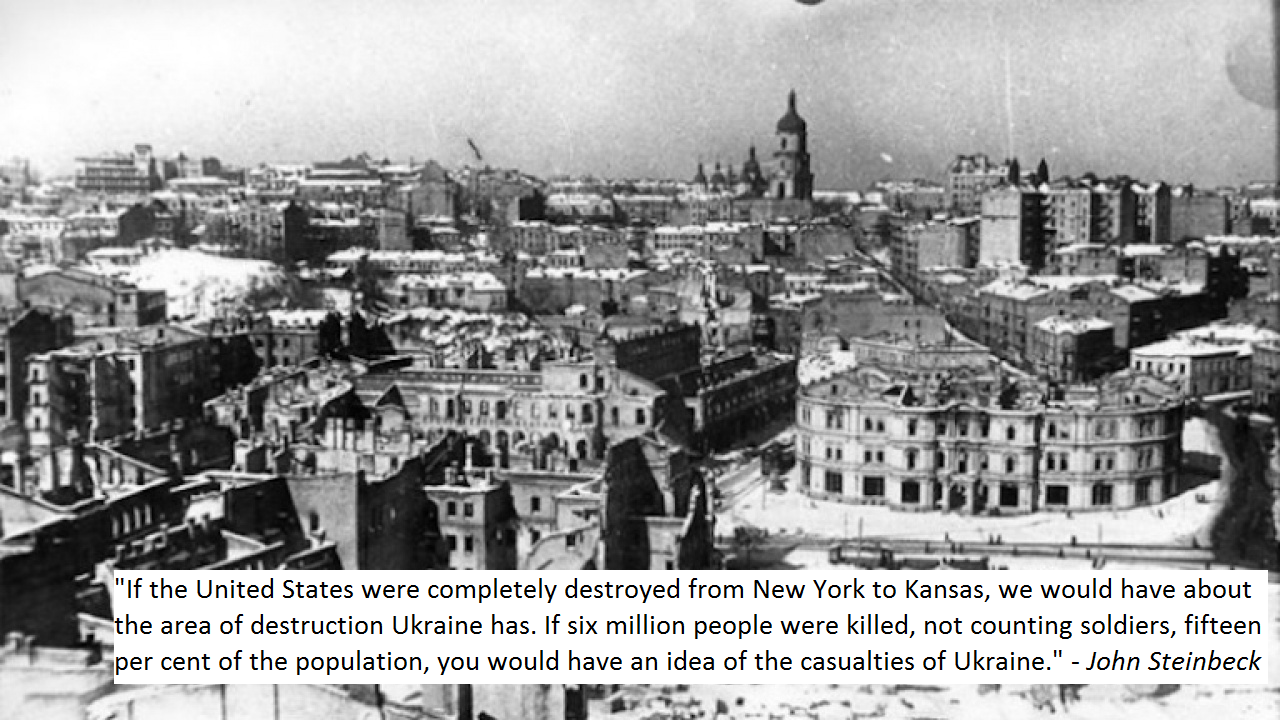
John Steinbeck describes post-WW2 Ukraine. (1947 Kyiv trip) >