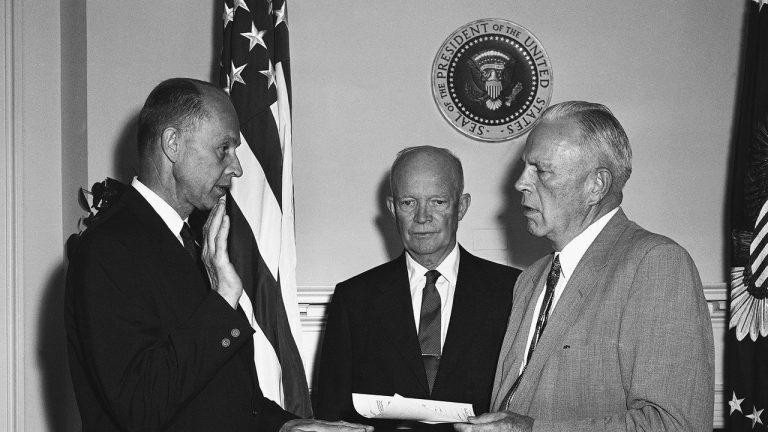
American journalist and historian Richard Rhodes, in his Pulitzer Prize-winning book The Making of the Atomic Bomb, named George Kistiakowsky a key figure in creating the first US atomic bomb:
“The US Government called on Dr. Kistiakowsky to help solve the problem with the new weapon the physicists at Los Alamos had been struggling for some time already with – they could not create an implosion capable of igniting the atomic bomb’s plutonium core. George Kistiakowsky joined the Manhattan Project in 1944, replacing Seth Neddermeyer as head of the Explosives (“X”) Division for the National Defense Research Committee responsible for the explosive components of fission weapons.
The implosives was the only real hope for the Trinity Device to work, but it was so hard to make, that at one time Robert Oppenheimer considered resigning his directorship because of it. Kistiakowsky recalled: “So much pessimism was developing about our ability to build satisfactory lenses, that Captain Parsons began urging (and he was not alone in this) that we give up lenses completely and try somehow to patch up non-lens type of implosion.” Kistiakowsky introduced the most dramatic innovation of finishing the high-explosive castings by machining them – In February 1945, Kistiakowsky chose an explosive called Composition B to serve as the fast-burning component of Fat Man’s lenses. It had to be poured as a hot slurry of wax, molten TNT, and other components and then cooled in certain ways to avoid air bubbles inside the large castings fifty pounds and more each…
The explosive was poured in and then people sat over that damned thing watching it as if it was an egg being hatched, changing the temperature of the water running through the various cooling tubes built into the mold.” Because of Kistiakowsky’s precision approach, there was not a single explosive accident in over 50,000 machining operations on those castings. It was under Kistiakowsky’s leadership that the complex explosive lenses capable to compress the plutonium sphere to achieve critical mass were developed…
On April 11, 1945, Oppenheimer sent Groves the news that Kistiakowsky had managed to produce implosive compressions so perfectly symmetrical that their numbers agreed with theoretical prediction. Truman postponed the conference with Stalin and Churchill in Potsdam until July 15 on purpose to give the Los Alamos team more time. To make sure the President had news of the test during the conference, the test date was set on July 16. Successful test of the atomic bomb would be a substitute for Soviet entry into the Pacific war.
By July, the pace of the whole test depended on the delivery of full-time molds for the implosion lens segments and Kistiakowsky’s group worked night and day to make them, but the air cavities in the interior of the castings produced too many rejects. The team was able to detect the cavities by X-ray, but could not repair them.
July 9 Kistiakowsky, “in some desperation”, got hold of a dental drill and, not wishing to ask others to do a dangerous job, spent most of the night, the week before the Trinity test, drilling holes in the faulty castings as to reach the air cavities. “You do not worry about it,” he will comment later. “I mean, if fifty pounds of explosives goes in your lap, you won’t know it.”
The same day, the Creutz group fired the Chinese copy, measured the simultaneity of its implosion by the magnetic method and made a conclusion that Trinity bomb was likely to fail.
“So of course,” Kistiakowsky recalls, “I immediately became the chief villain and everybody lectured me…Everybody at the headquarters became terribly upset and focused on my presumed guilt. Oppenheimer, General Groves, Vannevar Bush – all had much to say about that incompetent wretch who forever after would be known to the world as the cause of the tragic failure of the Manhattan Project…
At another point Oppenheimer became so emotional that I offered him a month’s salary against ten dollars that our implosion charge would work.”
Early morning July 16, the day of the test, Kistiakowsky found the control post rather crowded, “and having now nothing to do, I left as soon as the automatic timer was thrown in… and went to stand on the earth mound covering the concrete dugout. (My own guess was that the yield would be about 1 kiloton, and so five miles seemed very safe…”
The blast knocked him down at S-10000. He scrambled up, watched the fireball rise, mushroom auras, and moved back to the control panel. “I slapped Oppenheimer on the back and said, ‘Oppie, you owe me ten dollars.’
The distracted Los Alamos director searched his wallet.
“It’s empty,” he told Kistiakowsky, “you’ll have to wait.”
How Kyiv-born Kistiakowsky made his way to the USA >